
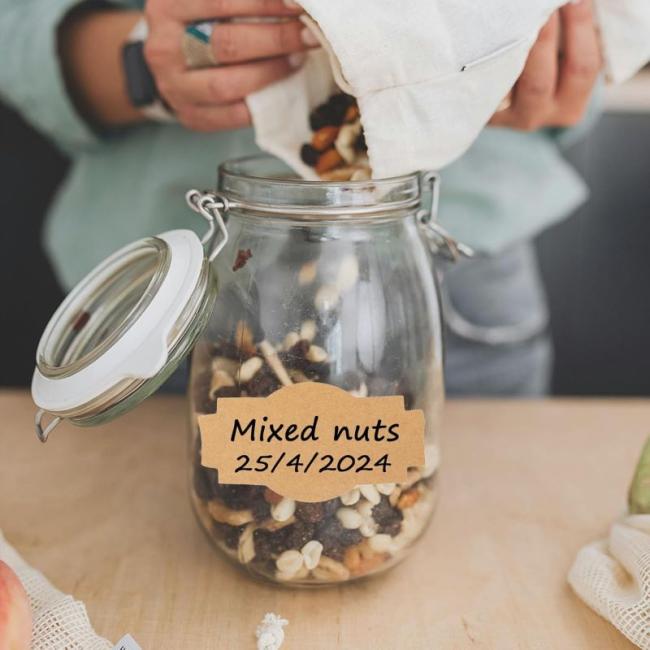
- Face: kraft paper, grade and surface treatment identified
- Appearance: approved brown tone, texture and printed reference
- Purpose: converted retail and packaging identification
- Paper grammage, print process and protection: agreed grade
- Adhesive, liner, shape and roll or sheet layout: matched to the pack and equipment
Finished kraft paper labels are selected for the artwork, pack and application process.
This page covers converted retail-packaging labels. For blank kraft A4 sheets printed in-house, compare the dedicated A4 page. In either route, paper, print, adhesive and liner must be matched to the actual equipment and surface.
Applications and Evaluation
- Jars and bottles: assess curvature, condensation and handling on the actual pack.
- Coffee, tea and other pouches: test the film surface and pack movement.
- Gift and craft packaging: approve texture and printed colour together.
- Retail product information: check small text and barcode contrast on the brown face.
- Cartons and small-batch parcels: confirm surface condition and application method.
Compare the related material and printing routes below.
Key Features
Proof colour on the selected paper
Use the actual brown stock and intended ink, toner or ribbon. Check fine text, colour shifts and scan contrast; a white-paper proof is not a substitute.
Qualify the print and delivery format
Specify a printed finished label, a blank roll or a sheet for in-house printing. Match the complete construction to the machine rather than assuming all kraft paper accepts every process.
Trial the complete pack
Name the jar coating, plastic type, board finish and curvature. Inspect adhesion and edges after the planned handling, moisture and storage exposure.
Keep material claims traceable
A brown appearance does not establish them.
Technical Specifications
The Specification section lists the agreed supply options. Confirm the following before approving a grade.
- Paper grade, brown reference and surface treatment are identified before proofing.
- Print method, liner and die-cut layout are confirmed against the supply workflow.
- Adhesive and any moisture or storage target are validated on the actual packaging.
Custom requirements are assessed against the proposed construction and a reference sample.
How to Select and Order
Fix the construction before a sample is made. Each part below says what it decides, the options available, and what we need from you.
1. Face stock — kraft varies, and that is part of the product
Unbleached kraft paper. Shade and fibre vary between batches; that variation is inherent to the material, not a defect.
What we need from you: Whether the kraft label must match a kraft bag or box exactly. If it must, send the reference material — matching two kraft substrates across two suppliers rarely happens by description.
2. Adhesive
Permanent acrylic · hot melt where the surface is rough or fibrous.
What we need from you: The surface — kraft paper, corrugated board, glass or plastic. Kraft labels are usually applied to paper-based packs, where fibre tear, not adhesive failure, is the risk.
3. Liner
Glassine liner, standard.
What we need from you: Your applicator type and the format you handle.
4. Service conditions
Kraft is uncoated, so it takes moisture and grease faster than a coated label. On a retail pack that is fine; on a chilled or greasy pack it is not.
What we need from you: Grease or moisture contact · retail handling · expected service life · whether the label must survive a chilled display.
5. Printing and converting — kraft absorbs ink
Flexo and screen are the usual routes. Kraft absorbs ink, so fine detail and light colours lose definition; one or two solid colours reproduce best, and white usually needs a base layer.
What we need from you: Your artwork and the colour reference. If the design depends on fine type over kraft, send it — it may need a different face or a white underprint.
Before the order runs
- Send artwork, colour reference, pack surface, dimensions and intended print method.
- State the application process, handling and any cold or moisture exposure.
- Approve the printed and applied sample, then confirm paper, adhesive and supply layout.
Send the artwork, surface, equipment and quantity to request samples and confirm the construction.
Related: Art Paper Labels · Kraft A4 Labels · Eco Labels · Paper Labels · Paper vs Film Labels: Choosing by Application
FAQ
Can the stock run in a laser or inkjet printer?
Confirm the finished label, adhesive, liner and equipment requirements. Use a trial rather than relying on the paper name.
Will it hold on a chilled jar or flexible pouch?
Assess the actual surface, application and service conditions. Check condensation, movement, edge lift and print on an applied sample.
How is this different from kraft A4 sheets?
This page selects finished packaging labels and converted formats. The A4 page focuses on blank sheets for the specified in-house printing workflow.